
Logic School Pedagogy
At The Cambridge School, traditional middle school years of seventh and eighth grade are referred to as the logic school. During these years, students begin to shift from mastering foundational knowledge to thoughtfully engaging with it. Building upon the habits formed in the grammar stage, they learn to reason from a posture of empathy, considering multiple perspectives before arriving at principled conclusions. Through a Socratic model of inquiry, students are invited into dialogue and debate, honing their ability to argue with both clarity and charity. Logic emerges not merely as an isolated subject, but as a guiding framework across disciplines, equipping students to more effectively access and articulate truth, reason soundly, and engage with the world around them from a posture of enthusiasm, understanding, and discernment. And, as is true across all stages of education at The Cambridge School, the classroom remains a space where teachers, as masterful guides, foster a love for truth, goodness, and beauty, modeling the intellectual and moral virtues they seek to cultivate in their students.
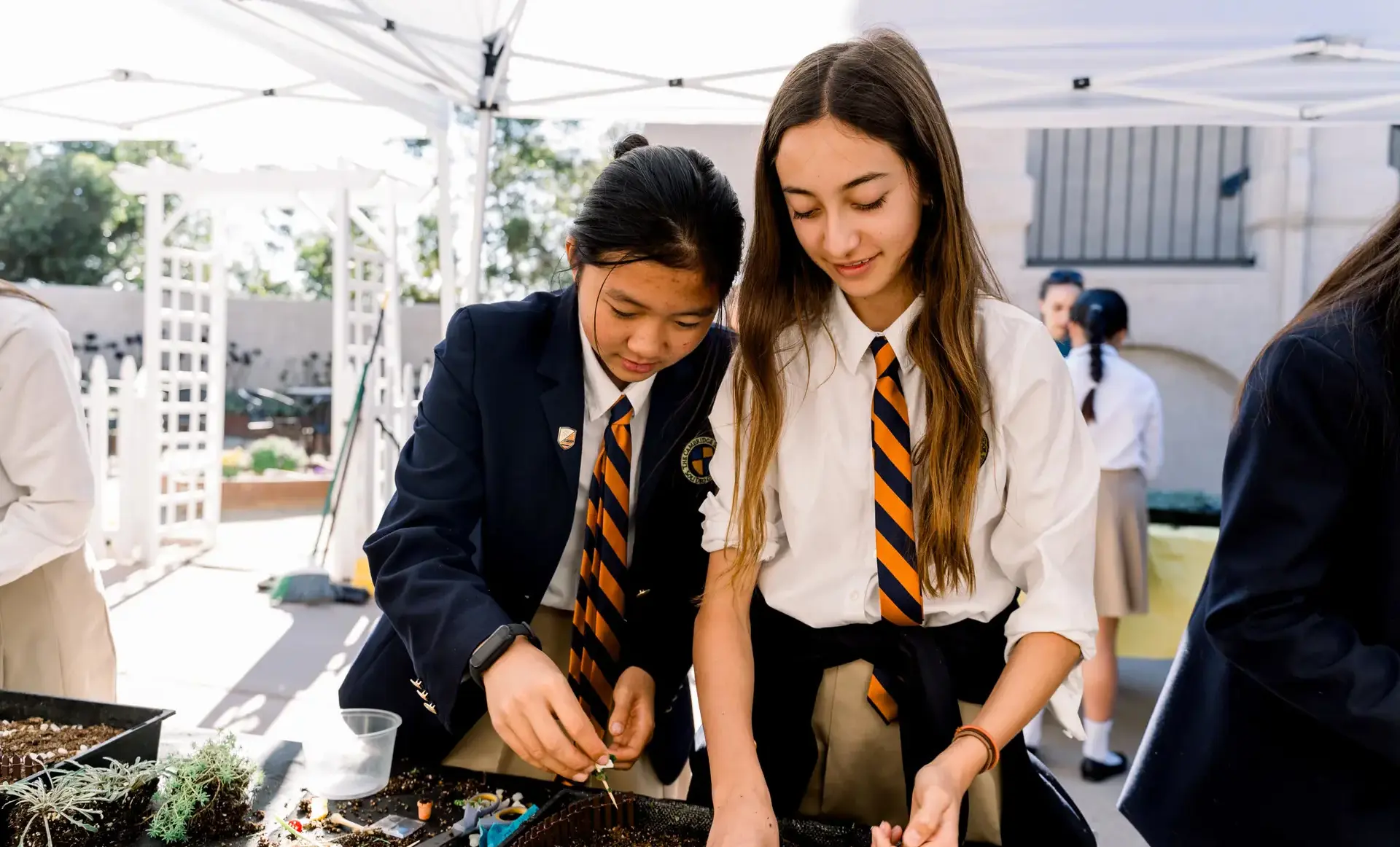
Logic School Culture
While imitation remains a pedagogical tool at all stages of education at The Cambridge School, the logic stage equips maturing adolescents with increased autonomy as they begin to find and refine their own voice in conversation with the great works of the past, their teachers, and their peers. Classroom discussions and Socratic seminars are animated, inquisitive, and fruitful. Students are taught to attend to diverse voices while staking their own claim within a community of motivated truth-seekers.
Logic
When children become naturally argumentative, the logic stage teaches students to engage in debate and discussions thoughtfully and charitably.
Students are taught Socratically and are trained in informal and formal logic. This logical training spans all disciplines and is cultivated in tandem with intellectual and moral virtues.
Rhetoric
The culmination of a rich and intentional education, the rhetoric stage introduces greater nuance and further complication to the foundational skills gained in the previous stages.
This rhetorically oriented education strives to cultivate students who are fluent in multiple literacies and equipped to thoughtfully dialogue with the many competing voices around them.
Socratic Model of Inquiry
A teaching method based on asking and answering questions to stimulate critical thinking and illuminate ideas.
Informal Fallacies
Logical errors in reasoning that occur in everyday language and arguments.
Argumentation Structures
The frameworks used to construct and analyze arguments.
Formal Logic
The study of reasoning with strict principles and structures.
Analytical Postures
The attitudes and approaches adopted for critical examination of ideas, encouraged to develop thoughtful analysis.
Pedagogical Tool
An instrument or method used to facilitate teaching and learning, with classical education employing tools like the Socratic method and classical texts.
Socratic Seminars
Structured discussions based on Socratic questioning, allowing students to explore complex ideas collaboratively.
Socratic Model of Inquiry
A teaching method based on asking and answering questions to stimulate critical thinking and illuminate ideas.
Formal Logic
The study of reasoning with strict principles and structures.