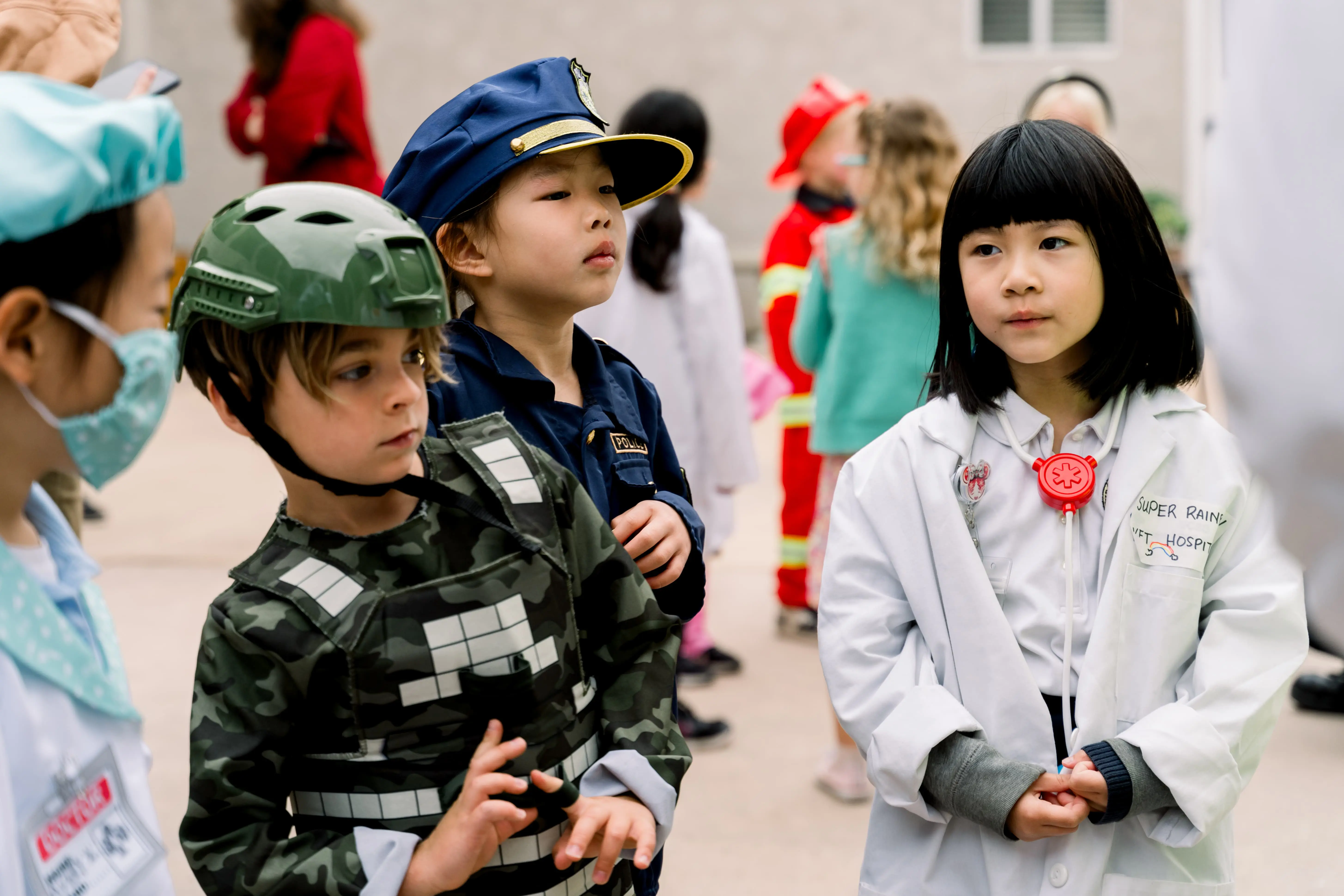
Kindergarten marks a child's first full step into the Grammar School years: the beginning of formal reading, the first sustained encounter with numbers and their patterns, and the start of a habit of attention that classical education is built to cultivate. At The Cambridge School, Kindergarten is taught by teachers who know that a five- or six-year-old learns best through repetition, rhythm, and delight, and who shape each day around that truth.
The Year, in Full
What Kindergartners Learn
Words, Read and Told
Reading begins with sound: Kindergartners learn to hear and blend the individual sounds inside spoken words before connecting those sounds to letters through flashcards, dictation, and word sorts. As decoding becomes second nature, attention shifts to fluency, then comprehension. Alongside their own reading, students retell and act out classic stories such as The Three Little Pigs and The Little Red Hen, learning to hold a story's shape before they can read it themselves.
A Place in the World, and in the Story of God
History gives Kindergartners their first sense of time and place: Christopher Columbus, Abraham Lincoln, the Thanksgiving story, the seven continents, and the maps and directions that locate their own community in the wider world. Bible study runs alongside it, tracing the character of significant Old Testament figures through catechism questions and answers, the beginning of a vocabulary for faith they will keep building for thirteen years. Scripture, hymns, chants, and poetry tied to both subjects are memorized throughout the year, training young minds to hold what they've learned and return to it.
Number, Pattern, and the Created World
In math, concrete objects come before abstract symbols: number patterns, word problems, addition and subtraction to ten, measurement, telling time, money, and ordinal numbers. Science turns that same careful attention outward, to the seasons, the human body, plants, insects, farm animals, and life cycles, learning to see the natural world as an expression of God's creation.
Latin, Art, and Music
Latin vocabulary is learned through songs, games, and pictures, the first step in a language sequence that continues through Grammar School. In art, students learn the elements of line, shape, color, and pattern, and study the lives of well-known artists. In music, they explore orchestras and marching bands through Prokofiev's Peter and the Wolf and learn rhythm and melody through the Orff method.
Body and Friendship
Physical education builds fundamental movement skills through warm-ups, skill practice, games, and Motor Lab, a program designed to support academic learning through physical development. Kindergartners also grow as friends: a rhetorical thinking curriculum, Feuerstein's Instrumental Enrichment, and The Incredible Flexible You teach flexible social thinking through story and structured play.
“
I look forward to leading and guiding the Kindergarten students in their discovery of God's creation.
Mrs. Aimy Ferdyn · Kindergarten Teacher
[8:1]
Student–Teacher Ratio
[7]
Hours per Day
[3-5pm]
Aftercare Available
Every family wonders whether their child is ready for this step. Take our Kindergarten Readiness Assessment, or reach out directly — our admissions team is glad to talk through readiness individually with any family considering Cambridge.
Admissions
From Kindergarten Through Twelfth Grade
A Cambridge Kindergartner is beginning a path that continues, uninterrupted, through Grammar School, Logic School, and Rhetoric School to graduation.
Schedule a Visit Apply Now